"Gardening makes my heart bloom" -- mum

"The hardest thing of all is to find a black cat in a dark room, especially if there is no cat." -- Confucius

Friday, 8 October 2010

Rose hip jam

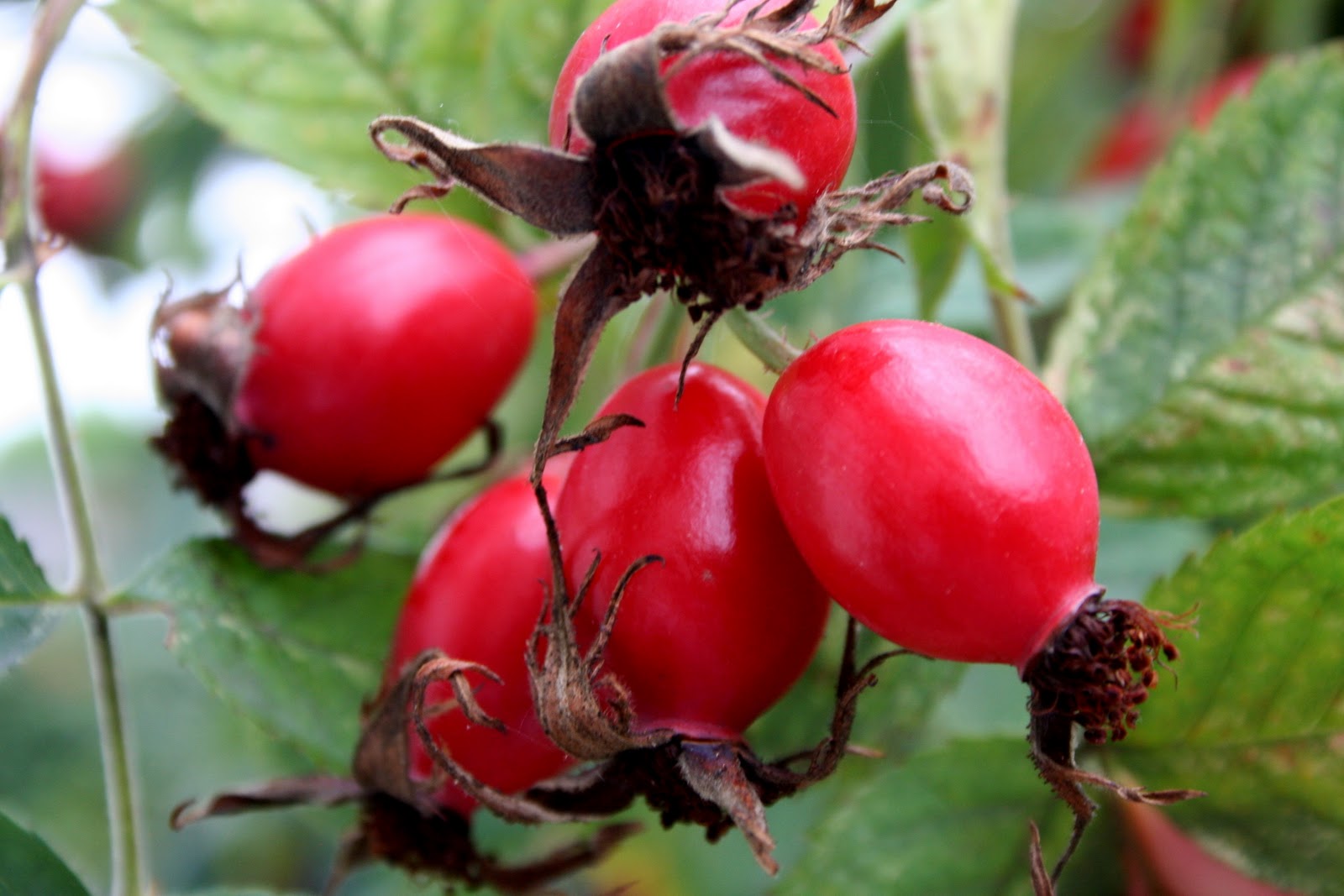
I had not considered roses as being 'edible' until recently when I noticed that the rose bush by the front door was absolutely dripping with rose hips.  The hips had turned a beautiful fire engine red and I thought it would be a terrible waste to let them fall to the ground.


Having read that jam, syrup, jelly, soup, pie and even wine could be made out of rose hips, I decided to give jam-making a go. 

I 'googled' and found this popular recipe from the 1700s:  1 pound prepared rose hip pulp, 1 cup water and 1 pound sugar.  There were no specifics on how to 'prepare' the hips - it seemed everyone had a different method.  Here's how I made mine......

 
Harvest carefully, wearing gloves and an old jacket to prevent scratches to oneself. 
Put the very ripe and soft fruit aside.  Select fruit which are firm and trim off both ends.
Cut these in half and scrape off the seeds with the sharp end of a vegetable peeler or knife. Try not to touch the hairy seeds (more on that later).
To prepare the softer fruit, hold firm the stem of the fruit and gently pull the 'bunch' of seeds off from the other end - easy!
Rinse the cleaned fruit to remove any leftover hairy bits.  Here's the thing about the fine hairs on the seeds: they work like itching powder.  Rub some on the skin and you will feel it!  If you're very sensitive, wear gloves when processing the fruit.
Pour the prepared hips and water into a heavy-based saucepan, cook until soft enough to press through a stainless steel sieve.
Sieve the pulp in small batches into a large bowl.
These were the skins left over from 1.5 pounds of rose hips.  Flick these onto the garden beds.
Pour the fine pulp back into the saucepan, stir in the sugar and bring to a boil.  Boil for several minutes and then simmer until there's a 'jam-like' consistency.
Rose hips have plenty of pectin, so there's no need to add anything else to help it set.  Once the mixture is thick, glossy and silky, test for setting point. 
Voila! Only four bottles after all that work but the taste is well worth the effort.
As I prefer a less sweet jam, I used 1 pound organic natural demerera sugar to 1.5 pounds rose hip pulp and two cups of water.  This jam is soft and silky and has just the right balance of tartness. 

Monday, 27 September 2010

Malaysian Night at Trafalgar Square

Ok, so Friday was grey, a tad wet and absolutely freezing.   Never mind that.  I read about 'Malaysia Night at Trafalgar Square' in a Time Out newsletter and decided to join a gaggle of diehard foodies to support this event.  Braving arctic conditions (by my calculations, that would be anything below 10˚C),  I arrived to the sounds of Malay traditional music and the heady smells of hawker food.....  


and it looked like the entire expatriate Malaysian (and Singaporean) community had decided to follow their stomachs as well!  A huge festive crowd was already there, tucking into Penang laksa, char koay teow, beef rendang, ayam percik, satay, chendol.....   


Most people sat around the fountains to eat their food but this gentleman here has demonstrated a most elegant way to tuck in standing up.....

What style!
Mmm.....check out the menus!  In my haste to satisfy my taste buds, all thoughts of food photography flew out the window.....until the very last dish, rojak. 


Rojak is a salad made from cucumber, jicama, bean sprouts, pineapple, green mango, Malay apple, guava and fried tofu puffs - ingredients will vary.  The dressing, the vital part of this salad,  is dark and viscous and made up of shrimp paste, tamarind paste, sugar, chilli and lime, topped with crushed roasted peanuts and a sprinkling of sesame seeds - salty, sour, sweet and spicy - the flavour is out of this world!
Rojak
Imagine buying kicap manis or fresh birdseye chilli in the middle of Trafalgar Square!

Maggi chilli sauce for sale here
.....and kicap manis here
Champion carver Weng Kit Ho flew in from Paris to present a stall full of fruit and vegetables.....

Royal stamp of approval
I might add that the entertainment was pretty good too:  traditional music and dance, parade of ethnic costumes, demonstration of the martial art of 'silat'.....


Folk dance

Silat
Malay musical instruments

Unfazed by the steadily dropping temperature and spurred on by the tantalising smells of food, the crowd grew and grew.....

The brightly lit National Gallery overlooking the event
Foodies are a very patient lot!
This event was part of a year long campaign by the Malaysian government to introduce the British to Malaysian cuisine (http://www.malaysiakitchen.co.uk/).  All participating food stalls in this event were run by Malaysian restaurants based in the UK.  A jolly good idea well executed!

Wednesday, 22 September 2010

Mooncake Festival

Lotus seed filling with double salted yolk mooncake
The Mooncake Festival, also known as the Moon Festival, Lantern Festival or Mid-Autumn Festival, is celebrated on the 15th day of the 8th lunar month.  The date is never the same as it is determined by the September equinox – when daylight and darkness are equal in length.  This year, the festival falls on the 22nd September.  [According to Wikipedia, the equinox occurs on the 23rd September at precisely 03:09 UTC.  UTC (Coordinated Universal Time) replaced GMT as the basis for the main referene time scale in various regions on 1 January 1972.]

This festival is celebrated by many East Asian and Southeast Asian cultures.  On this day the Chinese pray to the Moon Goddess for protection, family unity and good fortune.  Round mooncakes are eaten as it is symbolic of family unity and closeness.  Today, this custom has become less popular with 'city folks'.  In fact, the Moon Goddess had ceased to exist for some in the late sixties when some astronaut placed his big fat footprints on the moon!
Red bean (adzuki) filling with salted yolk mooncake
My best memories of living in the tropics were of going to my grandparents’ house on festival night where four generations gathered to eat, pray and play (for the adults, some small scale gambling!).  We sat outdoors to watch the moon rise, formed a procession of lanterns, played with sparklers and fireworks, listened to stories and sang.  Vast quantities of mooncakes, pomeloes, sugarcanes, groundnuts, sunflower and pumpkin seeds, sarsaparilla, orange squash and beers were consumed.  When the moon had risen high enough, we gathered at the altar to light joss sticks and prayed for the family’s health, wealth and happiness through the year.  This would include asking for good exam grades for the children! Then it was all hands on deck to build a mountain of joss paper to be burnt as offerings.  These were folded paper creations in the shapes of lotus flowers and taels (ancient Chinese gold ingots) that had taken days and weeks to make.  The bonfire was the highlight for me.
Moon rising over the back garden during the September equinox
There are many legends relating to this festival.  The one told to me by my dad and which made the most sense relates to the overthrow of Mongol rule in China.  During the Song dynasty when the Mongols invaded and captured Southern China, the rebel leaders came up with a plan to communicate with the people without raising suspicion.  Cakes shaped like the moon and stuffed with sweet fillings were made.  Inside each cake was a piece of paper with the message: ‘rise against the Tartars on the 15th day of the 8th Moon'. On the night of the rebellion, the full moon lit the way and those who were unable to fight or were injured hid in sugarcane plantations to escape slaughter by the Mongols. The Mongols were eventually overthrown and the Ming dynasty was created.

Happy Mooncake Festival!

Thursday, 16 September 2010

Mangetout 'Golden Sweet'

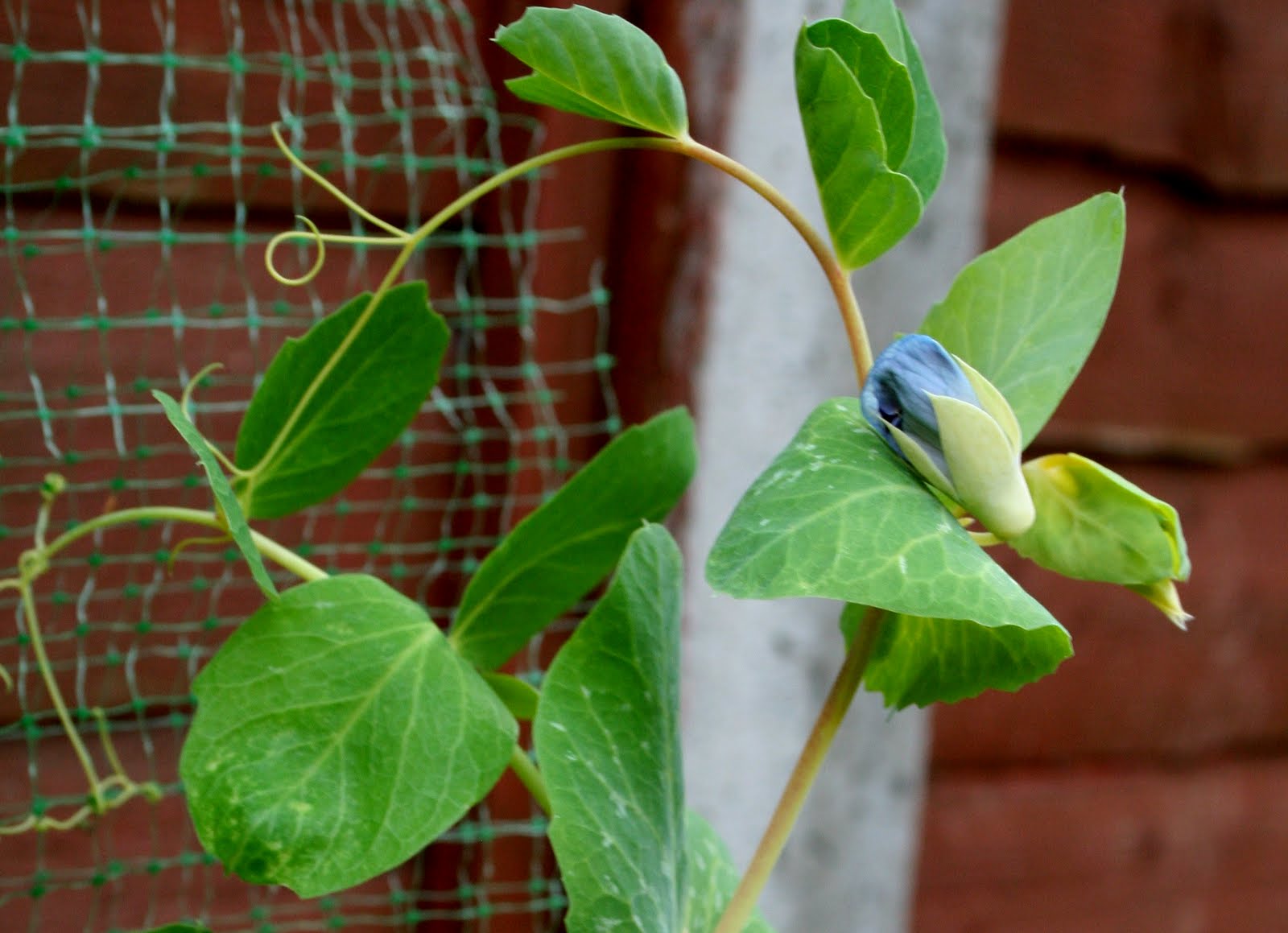
In recent months, I've been thoroughly entertained by this yellow-podded mangetout pea, my first foray into mangetout growing. The peas were a rare heritage variety supplied by the Real Seeds Catalogue.   Fifteen peas were sown in mid-April and fifteen plants transferred to the pea patch in May.  The plants grew very fast, climbing to the top of the 5 foot high netting in no time and would have kept on going if there were something to cling to!
Mauve flowers
I don't know if this is true of all mangetout but this variety does put on quite a show.
Purple flowers
Every single flower dances through hues of light pink, magenta, mauve, purple, blue.....
Blue flowers
... and finally fades away to reveal the loveliest lemon yellow pod.
'Golden Sweet' mangetout
What a feast for the eyes as well as the tummy!
Bountiful

Wednesday, 15 September 2010

Aussie Green Man

Here in the UK and in other cultures, the mythological Green Man has a face made up of leaves, sometimes with branches or vines sprouting out of its head and/or body.  I discovered this wonderful not so Green Man in the form of an old gum (eucalyptus) tree near a busy street corner in Leederville, Perth, Western Australia.  Can you see his sleeping face?  Small flocks of noisy cockatoos, rosellas and King parrots would take turns to perch on his head where I suspect there's a natural hollow for nesting. 
Aussie Green Man

Tuesday, 14 September 2010

Garden security

A helping hand from my mates.....
Border patrol
Keeping an eye out for vermin
Whoops...asleep on the job
Karate cat
Knackered

Sunday, 12 September 2010

Tumbleberries

The tumbleberry is a remontant strawberry - it crops heavily all summer and autumn.  I planted these last year, dotting them all over the garden, some in shade and some in full sun, in good compost and in damp, clay soil.  All survived and grew into big clumps.  These do not produce runners.  To 'make' more plants, just break the clumps up, ensuring each bit has roots attached.

Tumbleberry flowers
Bountiful
The most successful clumps were those grown in pots in semi-shade as fruits were allowed to grow to a full size.  Those in the ground were usually half eaten by slugs, snails and creepy crawlies before they had a chance to grow any bigger.  Soil quality did not seem to matter.  Being buried under 6" of snow for a couple of weeks did not matter at all!
Breakfast!
The fruit is sweet and very fragrant, described by a friend as tasting like "bubblegum wine".  Definitely worth having in the garden.